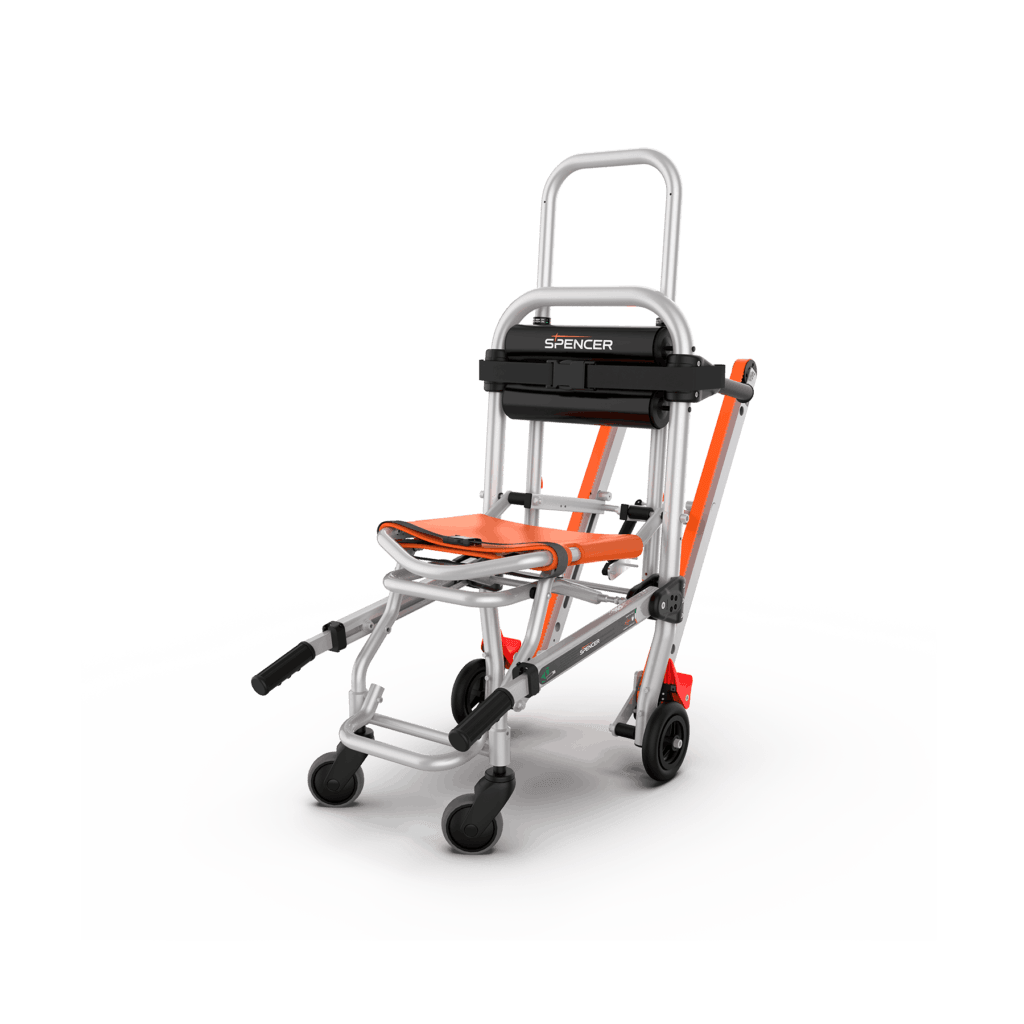
Evacuation Chair Buying Guide Ireland
An evacuation chair lets a trained operator move a person with reduced mobility down a staircase when the lifts cannot be used during a fire or other emergency. It is one of the most important purchases a multi-storey building can make, and one of the easiest to get wrong if you buy on price or appearance alone.
This guide is written for the people who buy evacuation equipment for Irish buildings: facilities managers, safety officers, nursing home and hospital managers, school principals and procurement teams. It covers the questions to answer before you buy, the differences between the models we supply, the accessories worth budgeting for, and the training your staff will need.
safetyequipment.ie is owned and operated by Phoenix STS, the fire safety and health and safety consultancy and training provider. The same team that supplies the equipment also delivers the training to use it, so you can deal with one supplier for both.
Who needs an evacuation chair?
Any building with more than one floor where a person might be unable to use the stairs unaided should consider one. That includes offices, schools, hotels, hospitals, nursing homes, colleges and public buildings. The need is not limited to wheelchair users. Visitors with injuries, staff recovering from surgery, pregnant employees and older people may all need help on the stairs in an emergency.
The starting point is the Personal Emergency Evacuation Plan, or PEEP. A PEEP records how a named person will get out of the building without using a lift. If any PEEP in your building relies on assisted escape down a staircase, you need equipment that makes that escape possible, and an evacuation chair is the most common answer for anyone who can sit upright. Phoenix STS prepares Personal Emergency Evacuation Plans for Irish organisations if you need help putting them in place.
What does Irish law say about evacuation equipment?
The Fire Services Acts 1981 and 2003 place a general duty on the person in control of a premises to take reasonable measures to guard against the outbreak of fire and to ensure the safety of people on the premises. In plain English, if someone could not leave your building safely in a fire, the person in control of that building has to answer for it.
The Safety, Health and Welfare at Work Act 2005 requires employers to prepare emergency plans and to provide what those plans need to protect employees. In plain English, an employer who knows a member of staff cannot manage the stairs must plan and equip for that person's escape in advance, not improvise on the day.
In residential care settings, Regulation 28 of S.I. No. 415 of 2013, which HIQA inspects against, requires adequate arrangements for evacuating residents. In plain English, a nursing home must be able to show that every resident can be moved to safety and that staff know how to do it. No fire authority or inspector endorses any particular product. Choosing suitable equipment is the duty of the building operator.
How do you assess your building before buying?
Walk the escape routes before you look at any model. Count the floors and note every staircase a chair might need to descend. Measure the stair width and, most importantly, the landings, because the landing is where the operator turns the chair between flights.
Landing size is the most common constraint in older Irish buildings. The Exitmaster models we supply each publish a minimum landing size on their product pages: the eGo needs 75 x 75cm, the Versa needs 80 x 80cm, the Versa Plus and Versa Elite need 90 x 90cm, and the Original needs 100 x 100cm. The Exitmaster range is designed for stair angles between 28 and 42 degrees, which covers most Irish stairs.
Then decide where each chair will live. A chair should be stored beside the staircase it serves, at the refuge area or landing where it will actually be used. A chair locked in a store room on another floor is no use in an emergency. Think about how many chairs the building needs: a single chair rarely covers a large multi-storey building with more than one staircase.
Which evacuation chair suits which building?
The eGo Evacuation Chair is the budget-friendly option in the Exitmaster range. It has an upright four-wheel design that needs only one operator for loading and travel, and it suits offices, schools and smaller buildings with standard stairs.
The Versa Evacuation Chair is the flagship model. It keeps the single-operator four-wheel design and adds a top step safety feature and a stoop-free operating position that gives the operator more comfort and control. It is the right starting point for most workplaces and public buildings.
The Versa Plus adds extra handles for easier movement along corridors, which matters in larger buildings where the chair travels a long way on the flat before it reaches the stairs. The Versa Elite is the premium model, with enhanced passenger comfort and safety on top of the corridor handles. Both suit hospitals, care settings and large campuses.
The Original Evacuation Chair is a traditional kickstand-style chair with a wall mounting bracket. It is the natural choice when you already hold kickstand-style chairs and want the new stock to match, so operators only train on one style.
You can compare the full range, including accessories, on our Evacuation Chairs Ireland category page.
Evacuation chair, mat or sheet: which type does your building need?
An evacuation chair suits a person who can sit upright and hold a seated position. It is fast on stairs, and the Exitmaster models above can be operated by one trained person. For most workplaces, schools and public buildings, a chair is the right first purchase.
Evacuation mats and sheets suit people who cannot sit upright or who need to be moved in or with their bed or mattress. They are the standard answer in hospitals and nursing homes, and the models we supply are designed for two trained operators. See our Evacuation Mats and Sheets category and our evacuation mat and sheet buying guide for that side of the decision.
Many buildings need both. A nursing home might rely on mats and sheets for bed-based residents and keep a chair at the day room on an upper floor. Make the decision person by person through the PEEPs, not building by building.
What accessories should you budget for?
A photoluminescent evacuation chair wall sign marks the chair's location and glows in the dark, so staff and visitors can find the chair in low light or smoke. At 10 x 39cm it fits above any wall-mounted chair, and it works with any brand of chair.
A fitted dust cover keeps a stored chair clean and ready. The Exitmaster covers are made from fire-retardant material and shaped to the chair, so they come off in one movement. Cabinets and floor stands are worth considering where corridors are busy or the chair would otherwise sit in a cleaning cupboard.
What training do operators need?
An evacuation chair is only as good as the person operating it. Operators should be trained by a competent trainer and should practise on the actual staircases they would use in a real evacuation. Practice should then be built into your fire drills so the skill stays fresh.
Phoenix STS delivers a practical Evacuation Chair Training Course for staff who will operate the chair, and an Evacuation Chair Instructors Course for organisations that want an in-house instructor to train and refresh their own people. Buying the chair and the training together means your equipment is usable from the day it arrives.
How do you keep an evacuation chair ready for use?
Build the chair into your fire safety management routine. Check that it is in its stored location, that the wall sign is in place, that the cover is fitted, and that belts, wheels and tracks are clean and undamaged. Record the checks in your fire safety register, and use the chair in at least some of your fire drills. Ask about servicing arrangements when you request a quotation so upkeep is agreed from the start.
What are the most common buying mistakes?
Buying without measuring. A chair that cannot turn on your landings will fail on the day, so check the landing sizes above against your own staircases first.
Buying one chair for a whole building. The number of chairs should come from your PEEPs and your staircases, not from a default of one.
Storing the chair away from the stairs, skipping operator training, and forgetting signage are the other three we see most often. Each one quietly turns a good purchase into shelf-ware. The fix costs little: store the chair where it will be used, train the people who will use it, and sign its location.
Evacuation chair FAQs
Do Irish buildings legally need an evacuation chair?
No law names a specific product. The Fire Services Acts 1981 and 2003 and the Safety, Health and Welfare at Work Act 2005 require safe means of escape for everyone in the building. In practice, if a PEEP relies on assisted escape down stairs, you must provide a workable way to do it, and an evacuation chair is the usual answer.
How many evacuation chairs do we need?
Enough that every person with a stair-related PEEP can be evacuated from where they actually spend time. In a multi-storey building that often means one chair per occupied upper floor at the staircase serving it. Review the count whenever PEEPs change.
Can one person operate an evacuation chair?
The Exitmaster chairs we supply are designed so one trained operator can load the passenger and travel, as their product pages set out. Some passengers will still need a second helper for the transfer into the chair, so let the PEEP decide the staffing for each person.
Do evacuation chairs go up stairs as well as down?
The models on this site are designed to take a seated person down stairs under control. If you need to move people upwards, or to move people who cannot sit, talk to us about evacuation mats, sheets and other options before you buy.
How often should operators refresh their training?
Common practice in Irish workplaces is a formal refresher at least annually, with hands-on practice during fire drills in between. An in-house instructor, trained on the instructors course above, makes frequent refreshers affordable.
What is a PEEP and who writes it?
A Personal Emergency Evacuation Plan is a short written plan for how a named person gets out of the building without a lift. The employer or service provider owns it and writes it with the person concerned. Phoenix STS can prepare PEEPs as part of its consultancy work.
How do you request a quotation?
Tell us the building type, the number of floors, your stair widths and landing sizes, how many chairs you need, any accessories, whether you want operator or instructor training, and the delivery county. We will come back with a written quotation. Every product on this site is supplied on an enquiry basis, so use the Request a Quote button on any product page, call 043 3349611 or email [email protected]. You can also read our quotation FAQ or send the details through our contact page.