Evacuation Mat and Sheet Buying Guide Ireland
Evacuation mats and sheets move people who cannot walk, and often cannot sit, to safety during a fire or other emergency. They are the core evacuation equipment of Irish hospitals, nursing homes and care settings, where lifts cannot be used in a fire and many residents cannot manage stairs or an evacuation chair.
This guide is for the people who buy this equipment: directors of nursing, facilities and household managers, safety officers and procurement teams. It explains the difference between sheets, mats and evacuation mattresses, how to match equipment to residents, what the building itself decides for you, and the training your staff must have.
safetyequipment.ie is owned and operated by Phoenix STS, the fire safety and health and safety consultancy and training provider. We supply the Hospital Aids and Tetcon evacuation ranges in Ireland and deliver the training that goes with them.
Who needs evacuation mats and sheets?
Any setting where a person may need to be moved while lying down: hospitals, nursing homes, residential disability services, hospices, and any building whose occupants include people who cannot transfer into a chair. The decision is made person by person through Personal Emergency Evacuation Plans, or PEEPs. A PEEP records how a named person gets out without a lift, and for a non-ambulant resident the answer is usually a mat, a sheet or an evacuation mattress kept at or near their bed. Phoenix STS prepares Personal Emergency Evacuation Plans if you need help building them.
What does Irish law say?
In residential care, Regulation 28 of S.I. No. 415 of 2013, which HIQA inspects against, requires adequate arrangements for evacuating residents and staff who know the procedure. In plain English, a nursing home must be able to show that every resident, including the least mobile, can be moved to safety by the staff on duty at night as well as by day.
The Fire Services Acts 1981 and 2003 place a general duty on the person in control of a premises to ensure the safety of people on it. In plain English, if a non-ambulant person could not be evacuated from your building, the person in control of the building is responsible for closing that gap.
The Safety, Health and Welfare at Work Act 2005 protects the staff doing the moving. In plain English, employees must have equipment and training that lets them evacuate residents without injuring themselves, which is why operator numbers and working load limits matter when you buy. No inspector or authority endorses a particular product; the choice and its suitability rest with the provider.
What is the difference between an evacuation sheet, mat and mattress?
An evacuation sheet stays fitted to the bed. The Evacuation Ski Sheet attaches under the mattress with elastic corner straps and stays there permanently, so in an emergency staff secure the straps over the resident and slide them to safety cocooned in their own mattress. The S-CAPEPOD evacuation sheet works on the same principle, with strap storage tunnels designed so the straps cannot snag in the frame of an adjustable bed.
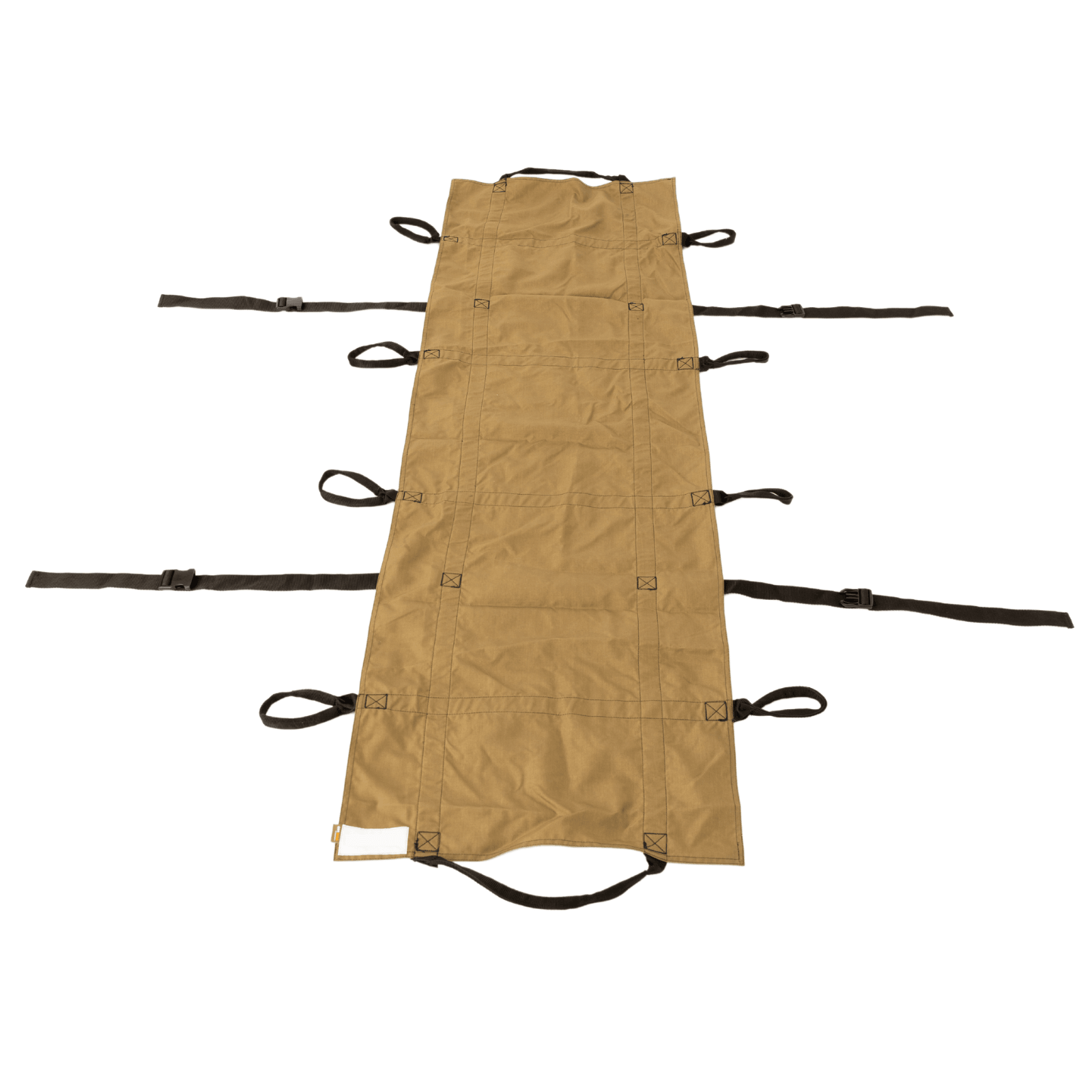
An evacuation mat is a separate device the person is transferred onto. The Ski Pad is a padded mat with a 5cm foam layer and a low-friction base, designed for congested wards, narrow corridors and single-width fire doors. The Medi-Mat adds side wings that cocoon the person, which helps residents who may be distressed or display challenging behaviour during a move, and it adjusts in length to the user. The AlbacMat is a flexible evacuation stretcher that packs very small, weighs about 2kg and glides over carpet, vinyl, concrete and grass, which makes it popular beyond healthcare in schools, hotels and transport settings.
An evacuation mattress is the most protective option. The S-CAPEPLUS inflatable mattress is a flame-retardant inflatable design supplied with a wall cover, and the S-CAPEKIDS version has four compartments so one or two carers can evacuate four babies at once, which is why it appears in maternity and early years settings.
How do you match equipment to residents and patients?
Start with mobility. A resident who can sit and grip may suit an evacuation chair instead, so read our evacuation chair buying guide alongside this one. A resident who must stay lying down needs a sheet, mat or mattress.
Then check weights against the published working load limits on each product page. As examples from our range: the Ski Sheet and Ski Pad list a safe working load of 120kg with two operators, the Medi-Mat lists 160kg, the Bariatric EvacMat lists 350kg, and the EMS version used by emergency services lists 400kg. If your service supports plus-size residents, buy the bariatric equipment now rather than discovering the gap during a drill.
Finally, think about the person, not just the load. Side wings, internal pillows, foot pockets and highly visible colour-coded straps all exist to keep a frightened person secure and a night team fast. Children need child-specific equipment, not a scaled-down improvisation.
How does the building change the choice?
Measure the route, not just the room. Narrow corridors and single-width fire doors favour the Ski Pad's slim profile. Long smooth corridors suit any low-friction base. Stair descents need equipment with proper handles and, for heavier residents, anchor points for ropes, which the Bariatric EvacMat provides for controlled stair work.
Storage decides speed. Sheets like the Ski Sheet and S-CAPEPOD live on the bed itself, ready in seconds. Mats and mattresses should be wall-mounted in their carry cases at the room, ward or refuge point they serve, never stacked in a distant store.
How many staff does an evacuation take?
Plan on two trained operators for mat and sheet moves. The product pages for the models above state their safe working loads on that basis, and night staffing levels should be checked against that need. This is exactly what a HIQA inspector will probe in a nursing home: not whether the equipment exists, but whether the staff on duty at 3am can use it for every resident who needs it.
What training do staff need?
Every manufacturer we supply states that users of this equipment must be trained by a competent person. Equipment that arrives without a training plan is not an evacuation capability, it is a box in a corridor.
Phoenix STS delivers the Healthcare Evacuation Equipment Instructor Course, which qualifies your own senior staff to train and refresh colleagues on mats, sheets and chairs, and a People Moving and Handling Course for the wider team. Buying equipment and training from the same supplier keeps the techniques and the kit consistent.
What are the most common buying mistakes?
Buying for the building average instead of the hardest case. The resident who is heaviest, most distressed or furthest from the stairs defines the equipment you need, and PEEPs are how you find that case before an inspector or a fire does.
Mismatching beds and sheets. Adjustable bed frames can trap conventional straps, which is the problem the S-CAPEPOD's strap tunnels were designed to solve. Check your bed stock before ordering bed-fitted sheets.
Storing equipment away from the point of use, skipping refresher training, and never using the equipment in drills complete the list. A mat that has never been unrolled in practice will not be unrolled smoothly in smoke.
Evacuation mat and sheet FAQs
What is the difference between an evacuation mat and a ski sheet?
A ski sheet stays fitted under the mattress and evacuates the person with their own mattress. A mat is a separate padded device the person is transferred onto. Sheets are fastest for bed-based residents; mats suit transfers from anywhere in the building.
Can one member of staff evacuate a resident on a mat?
The mats and sheets we supply publish safe working loads based on two operators, so plan staffing on that basis. The exception is equipment chosen specifically for single-operator use in other categories, such as certain evacuation chairs.
Do we need one evacuation mat per resident?
Not necessarily. Bed-fitted sheets are one per bed by nature. For mats and mattresses, the number comes from your PEEPs, your compartment layout and how many simultaneous moves your evacuation strategy assumes. A fire safety consultant can model this with you.
What weight can evacuation mats carry?
It varies by model: from a 120kg safe working load on the Ski Sheet and Ski Pad, through 160kg on the Medi-Mat, up to 350kg on the Bariatric EvacMat and 400kg on the EMS version. Always check the current product page for the model you are buying.
Do staff legally need training on this equipment?
The Safety, Health and Welfare at Work Act 2005 requires employers to provide the instruction and training employees need to work safely, and in plain English moving a person on a mat without training puts both the resident and the staff member at risk. The manufacturers also require training by a competent person.
How should evacuation mats and sheets be stored?
Sheets stay fitted to the bed. Mats and mattresses should be wall-mounted in their carry cases at the rooms, wards or refuge points they serve, checked routinely, and recorded in your fire safety register.
How do you request a quotation?
Tell us the care setting, the number of beds or rooms, the resident profile including any bariatric or paediatric needs, your bed types, the floors involved, and whether you need instructor or staff training. Every product on this site is supplied on an enquiry basis: use the Request a Quote button on any product page, call 043 3349611 or email [email protected]. Browse the full Evacuation Mats and Sheets Ireland category, read our quotation FAQ or send the details through the contact page.