Rescue Stretcher Buying Guide Ireland
Rescue and ambulance stretcher selection depends on the environment, casualty handling needs, transport method and compatible accessories.
Use this guide to identify the use case, handling requirements and quotation details before selecting stretcher products.
Choosing a rescue or ambulance stretcher
Confirm whether the requirement is ambulance, rescue, bariatric, stairway, confined-space, transfer or training-related.
For a quotation, include product names if known, quantities, intended use, delivery location and any strap, bag, mount or immobilisation accessory requirements.
Match the stretcher to the environment
Ambulance and patient transport
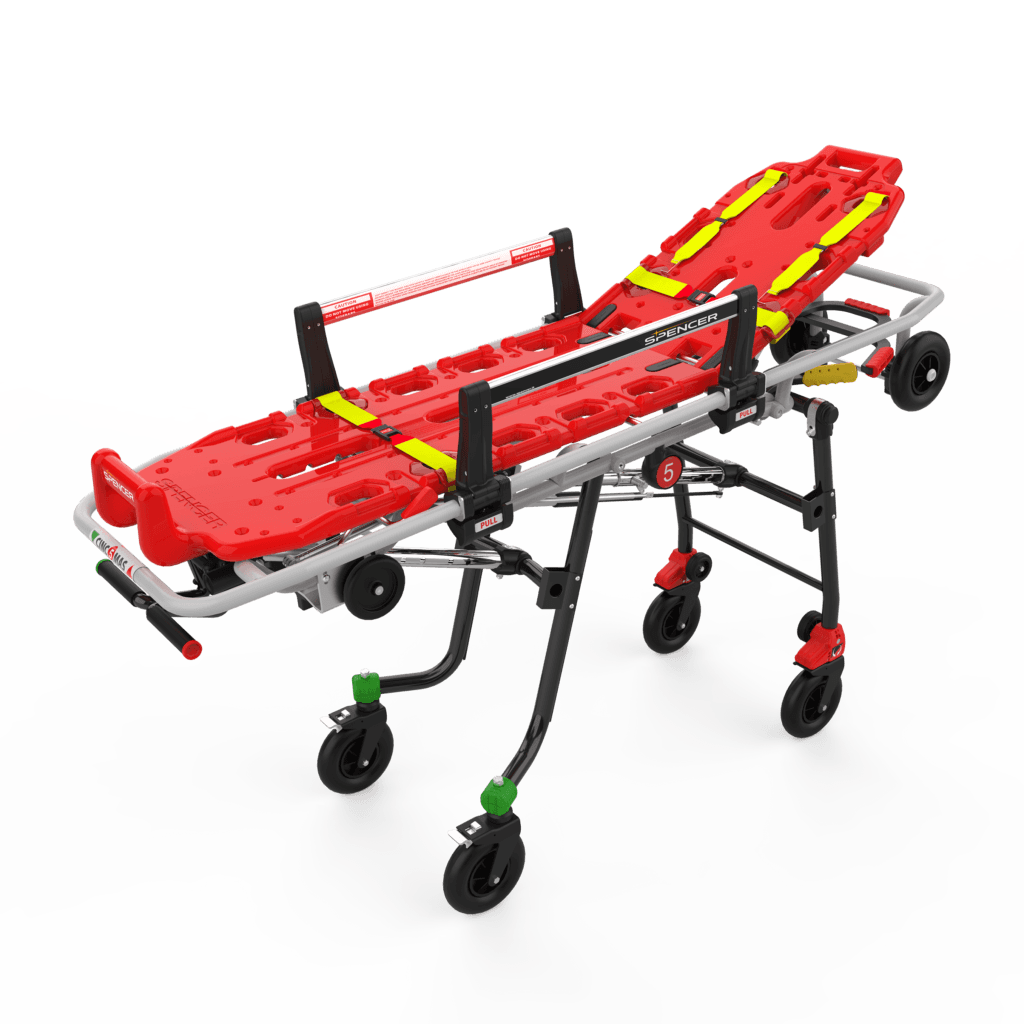
For ambulance work the core choice is a trolley stretcher: a wheeled platform with adjustable loading height, rear brakes and restraint belts that loads in and out of the vehicle. In the Spencer range supplied here, trolley models such as the Carrera Pro, Carrera Tec, Cross, Crossover and Cinco Mas carry load capacities of 170 kg or 250 kg depending on the model and configuration, with loading heights from 500 mm. The Crossover adds a shortenable frame and Trendelenburg positioning for tight lifts and clinical needs.
Rescue, remote ground and confined spaces
Where wheels are useless, on stairs, rough ground or in confined spaces, a flexible recovery stretcher carries the casualty by handles. The Spencer WOW recovery stretcher weighs 4.7 kg, folds for storage and carries up to 150 kg on ten handles, spreading the load across several rescuers.
Stairways inside buildings
Stair work is its own problem. A flexible stretcher with well-placed handles lets a trained crew control the descent, and for planned evacuation of people with reduced mobility an evacuation chair or evacuation mat or sheet is often the better tool. If the purchase is driven by building evacuation rather than casualty rescue, start with those categories and their guides.
Bariatric and higher-capacity needs
If your service regularly moves heavier patients, set the required load capacity first. Several Spencer trolley models are rated to 250 kg, but capacity can differ between versions of the same family, so confirm the rating of the exact product code on its product page or in your enquiry.
Accessories that complete the kit
A stretcher rarely travels alone. Restraint straps and belts hold the casualty securely; immobilisation equipment such as spine boards and stabilisation accessories supports suspected spinal injuries; carry bags and covers protect folded stretchers in storage; and emergency bags keep dressings and airway kit beside the casualty. Quoting these with the stretcher avoids compatibility surprises later.
Cleaning, storage and service life
Stretchers earn their keep over years, so plan for the unglamorous part: how the platform and belts will be cleaned and decontaminated between patients, where the stretcher lives between calls, and who inspects welds, wheels, brakes and belts on a schedule. The Spencer trolley models supplied here are listed with stainless steel and aluminium frames and polyethylene platforms; check each product page for materials and follow the manufacturer's cleaning guidance. Record inspections in your equipment register so service life is documented, not guessed.
Selection criteria that decide the purchase
Beyond the environment, the questions that settle a stretcher choice are practical. How many operators will be available for a lift? What loading height suits your vehicle? Does the stretcher need to shorten for lifts and corridors? How will it be cleaned and decontaminated between patients? Which restraint and immobilisation accessories, such as spine boards, straps and head blocks, must be compatible? Where will it be stored, and does it need to fold?
Write these answers into your enquiry and the quotation can cover the stretcher, mounts and accessories in one pass.
Equipment, training and the law
For workplace and voluntary services alike, the Safety, Health and Welfare at Work Act 2005 places a general duty on employers to provide suitable work equipment and the instruction and training needed to use it safely. In plain terms: buying the right stretcher is half the duty, and making sure crews can lift, load and secure a casualty with it is the other half. Phoenix STS, which owns and operates safetyequipment.ie, runs manual handling training and a people moving and handling course that pair naturally with stretcher purchases.
Useful product links
Rescue and Ambulance Stretchers - stretcher category page.
Immobilisation Equipment - spine boards, straps and stabilisation accessories.
Spencer Safety Equipment - manufacturer page.
Example products
Spencer Carrera Pro - trolley stretcher with configurations rated 170 kg or 250 kg.
Spencer Carrera Tec - trolley stretcher with configurations rated 170 kg or 250 kg.
Spencer Cross - trolley stretcher rated 170 kg with a shortenable frame.
Spencer Crossover - shortenable trolley stretcher rated 250 kg with Trendelenburg positioning.
Spencer Cross Up 8409 - trolley and stretcher combination rated 250 kg.
Spencer Cinco Mas - ambulance stretcher rated 250 kg.
Spencer WOW - folding recovery stretcher, 4.7 kg, rated 150 kg, with ten carry handles.
Rescue stretcher FAQs
What weight capacity do rescue stretchers have?
In the Spencer range supplied through this catalogue, load capacities run from 150 kg on the WOW folding recovery stretcher to 250 kg on trolley models such as the Cinco Mas and Crossover. Capacity is stated per configuration on each product page, so confirm the exact code in your enquiry.
Which stretcher suits stairs and narrow spaces?
A flexible recovery stretcher with multiple carry handles, such as the Spencer WOW, gets through where a wheeled trolley cannot. For routine stairway descent of a person with reduced mobility during evacuation, look at evacuation chairs as well.
How many people are needed to carry a stretcher?
It depends on the stretcher, the casualty's weight and the route. Handle counts give a clue: the WOW provides ten handles so several rescuers can share the load. Plan crew numbers as part of your manual handling assessment rather than assuming two people can manage.
What is the difference between a trolley stretcher and a recovery stretcher?
A trolley stretcher is a wheeled, height-adjustable platform built around vehicle loading: it rolls, brakes and lifts. A recovery stretcher is a flexible platform carried by handles, built to get a casualty out of places wheels cannot go. Ambulance services usually need both: the trolley for transport and a recovery stretcher for the awkward first fifty metres.
What details help with a rescue stretcher quote?
Include the stretcher type, intended use, quantity, delivery location and any accessory or compatibility requirements, such as straps, bags, mounts, storage or immobilisation equipment.
Quotation checklist
When requesting a quotation, include the product name or SKU, quantity, delivery location, user environment, required accessories and any relevant compliance or training needs.